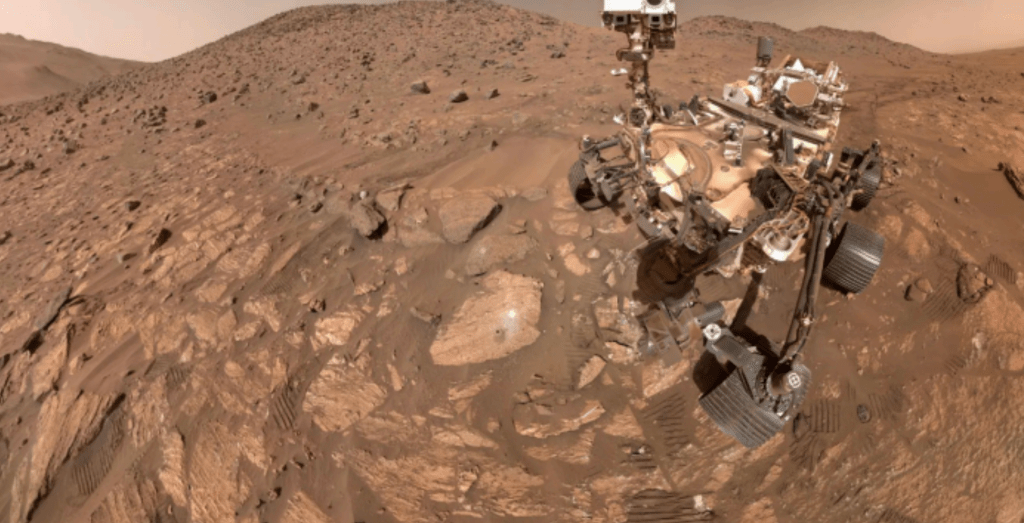
Are we really the only ones? The question that lingers in everyone’s brains when they watch E.T. for the first time. Only this time, NASA might actually have an answer. On September 10th, 2025, NASA announced that one of its rovers, Perseverance, found a sample that had signs of potential life on Mars. The sample is called “Sapphire Canyonne” and was taken from a rock, “Cheyava Falls”, in an ancient river bed in the Jezero crater.
Billions of years ago, water once flowed through Mars. Now, it is all dried up, but there are still formations that contain information about that time. The rover found Cheyava Falls while exploring a formation of rocky outcrops called “Bright Angel” on the northern and southern edges of Neretva Vallis, an ancient river valley measuring a quarter-mile wide in the Jezero crater. The sample Sapphire Canyonne found there contains layers of red-ish clay that formed when water still flowed throughout Mars. But why would some clay lead to the belief in microbial life on Mars?
There are three main reasons that NASA believes this could lead to signs of life on Mars. First, the sample had a “leopard spot” texture that is formed by chemical reactions that involve phosphate, and on Earth, those features are commonly associated with mineralogy being altered from microbes eating organic matter. The second reason is that the rover detected organic carbon, organic carbon is also the building block for living things on Earth. One of NASA’s Perseverance scientists, Joel Hurowitz, says that “The combination of chemical compounds we found in the Bright Angel formation could have been a rich source of energy for microbial metabolisms”. Lastly, the sample contained the minerals vivianite, iron phosphate, which forms in environments with decaying organic matter on Earth, and greigite, iron sulfide, which can be produced by microbes on Earth that use sulfate for energy. These two minerals are also a part of the redox gradient, a chemical process that can happen without life, but sometimes is so slow that living organisms need to accelerate it, meaning that there could have been microbial life to help that reaction occur within the sample.
Although nothing is yet confirmed about the possibility of microbial life on Mars, researchers and scientists will continue to do research and experiments on the sample found. To truly find out if there was at any point life on Mars, the sample Saphire Canyonne would need to be brought back to Earth to do advanced laboratory testing on it. These features on Saphire Canyonne could have appeared without biology, but this is the closest scientists have ever gotten to finding life beyond Earth, and it is inspiring to see how far technology and science can advance to hopefully find more clues in the future about what possibilities of life lie beyond a 7,900-mile-wide planet.




 The Red & White
Leave a comment