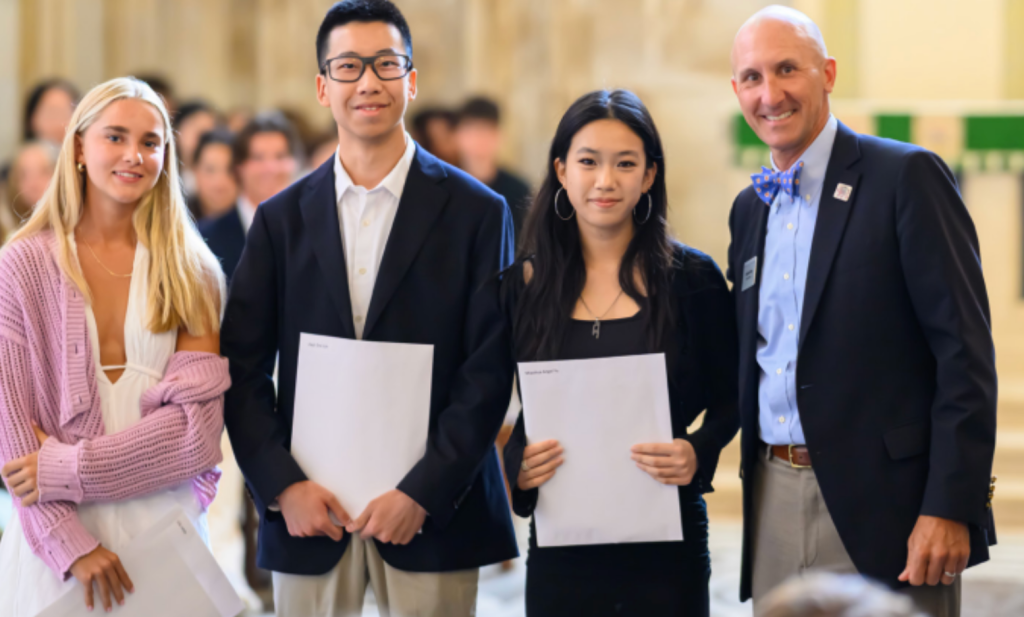
On the morning of September 4, 2025, the Hilltop saw a sun that streamed through the windows of the storied and beloved chapel; there, the annual Convocation service took place. The day arrived after an onslaught of orientation activities, frenzied move-in festivities, form meetings, and various social programming. Garbed in starch collars, pressed blazers, and flowy dresses, the student body filled the wooden pews with great anticipation for the year ahead. Head of School Michael Wirtz opened the service with rather banal patter about the “power” of the St. George’s community—then came the twist: he revealed to the audience that his opening remarks were generated by ChatGPT. Wirtz then crumpled up his speech, cast it aside, and proceeded to deliver a far more incisive message: “Shortcuts are almost always available,” he declared, “but they do not yield the best results; real learning, real growth, real improvement requires effort.”
Following Wirtz’s Convocation Chapel address, Associate Head of School Elizabeth Bickford introduced the new and Emeriti faculty members directly to the school community. Next, Dean of Academics Gretchen Boger enumerated the many students who earned awards for their scholarship and leadership.
Three sixth-formers—Lila Jette ‘26, Eric Lin ‘26, and Angel Yu ‘26—were inducted into the St. George’s chapter of the Cum Laude Society, a national organization committed to recognizing superlative scholastic achievement in high schools. Six additional students of various forms were named Top Scholars: Colin Spence Fitzgibbons ’26, Emma Fillmore Levi ’26, Eric Lin ’26, Antonio Mattera ’26, Angel Yu ’26, Alice Opal Tamsin Lank ’27, Leo Wu ’27, Jiaming Xu ’27, and Jessica Yao ’27.
A procession of awards was then conferred to those who displayed outstanding levels of scholastic achievement. Charlotte Li ‘28 claimed the highest scholarship in the third form; The Class of 1904 Prize, given to a student “for highest scholarship in the fourth form,” went to Jessica Yao ‘27; Emma Fillmore Levi ‘26 earned the same distinction for the sixth form.
Awards were also granted to students who distinguished themselves in academic disciplines ranging from STEM to the humanities to the arts. The Howe Prize, “for excellence in graphic arts,” honored Zoe Chen ‘26; the Pell Award, for distinction in United States history, was bestowed to Angel Yu ‘26; the Chinese Prize, “awarded to a student who has demonstrated consistently high performance in the study of Mandarin Chinese and shown a genuine interest in the Chinese language and culture while at St. George’s,” was presented to Cecile-Jeanne Gillin ‘26; the Rensselaer Prize, “awarded to a member of the fifth form for outstanding achievement in mathematics and science,” went to Henry Liu ‘26; and last—but certainly not least—the Robinson Chemistry Prize, presented to a student for excellence in chemistry, was awarded to Jiaming Xu ‘27.
The awards ceremony concluded with three awards honoring students who had exhibited exemplary leadership, scholarship, and character in the preceding year. The Allen Prize, “awarded to a member of the fourth form who during the year, in the opinion of the faculty, has maintained a high standard in all departments of the life of the school,” was given to Peter Duhamel ‘27; the Yale Prize, awarded by the Head of School to a sixth former for “for excellence in scholarship and character,” was presented to Zoe Chen ‘26; at last, the Harvard And Radcliffe Clubs Of Rhode Island Prize, “for the student of the fifth form whom the Head of School and the faculty deem most worthy in scholarship, effort, and character,” was awarded to Jules Patterson ‘26.
Following the ceremony, the chapel doors swung wide, releasing the St. George’s community into the crisp September morning as students and faculty scurried to their classes en masse—the new academic year had officially begun, and with it, the promise of all that lay ahead.


 The Red & White
Leave a comment