Imagine strolling along the grand boulevards of London’s affluent West End. Picture businesspeople on their way to work, shoppers perusing the windows of every fine boutique, or hopping onto one of the polished red buses—a picture of perfection in which you can believe Britain is the unequaled world power it once was.
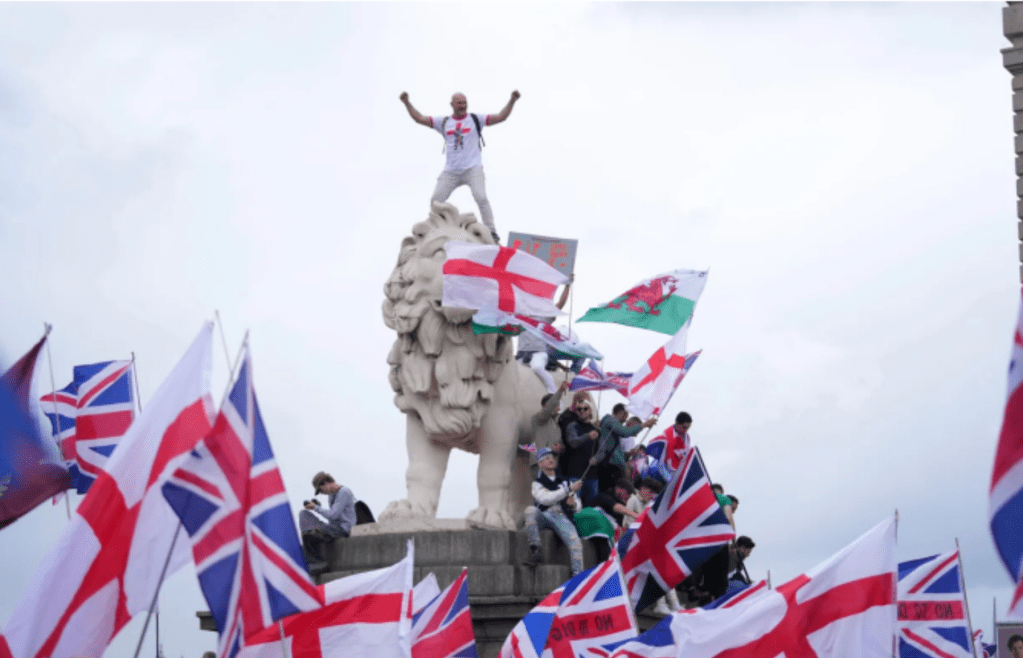
That picture, however, disintegrated on September 13th, 2025 when nearly a million people flooded the same streets, not in celebration but in rage. What we saw that day wasn’t a simple far-right rally, but a howl of a dying country weeping from its own contradictions.
The streets were thick with jeers about the prime minister, lashes against immigrants, insults toward Islam, and cries for a country that once was. This fury, no matter how ugly, comes from real despair; it was a symbol of a meandering economic, social, and political decline that’s plagued the Kingdom for eighty years.
Rising from the ashes of the Second World War, Britain became one of the most admired welfare states in the world. Universal healthcare, affordable housing, and reliable pensions were guaranteed, becoming the pride of a country that lost its empire. But beginning in the Thatcher era, that admired welfare state came crashing down in the name of privatization and “efficiency.” Furthermore, anti-union policies and financial deregulation fueled the decline of industrial regions like the midlands and the centralization of Britain’s economy in London. Today, Britons are dealing with the consequences of those decisions.
Wages haven’t grown since ‘08 while rent gobbles a third of take-home pay (if you’re lucky) and homeownership is a pipe dream for most. Exasperated by inflation, the UK has become a place where more than a full-time job is needed to live a decent life. Budget slashes to public services have been profound. Publicly-funded housing has collapsed while wait times for medical treatments can now take almost a year.
Amid economic chaos is an immigration crisis; the British government’s policies have been a series of bloopers, blunders, and millions flushed down the toilet. Migrants are housed in costly hotels while MPs and PMs bicker to find long-term solutions. It is no wonder many working-class Britons feel betrayed by their government when millions are spent on migrants yet state-backed housing projects collapse under budget constraints.
The emergence of multicultural Britain over the same years have created mass demographic shifts. Far right politicians employ this change to ignite fear among constituents, using the rise of Islam in particular. Intense rhetoric on all sides has only made things worse, especially concerning debate over the Union Jack—the UK’s Flag. On one hand, left-leaning factions see it as an offensive symbol representing the horrors of colonization. On the other hand, many moderate and right-leaning Britons celebrate the flag and feel wounded by the dispute. Young white male voters are especially drifting toward reactionary populism, driven by a nostalgia for a “white” Britain narrative.
Throughout all this, successive Conservative and Labour prime ministers have failed the country. Boris Johnson stumbled through Brexit with no plan for the future; Liz Truss wrecked the economy in 44 days; Sunak didn’t know how to deal with illegal immigration, saying they should be sent to “Rwanda.” Now Starmer, once a beacon for change, has become a symbol of indecision. Meanwhile, the streets of Birmingham, Manchester, Leeds, Nottingham, Glasgow, and, of course, London, burn.
Britain is not a country broken by immigrants, Islam, or young men. It’s broken because its leaders sold the country off piece by piece for short term profit and political gain. The United Kingdom is in the situation the United States was during the 1950s, the 1970s, and now: a house divided with the foundation crumbling under every stomp of every furious voice. But things can change. Once people cease blaming one another for symptoms and start confronting the root of the decay, the foundation can be fixed. Otherwise, the two countries will only march into deeper chaos.




 The Red & White
Leave a comment