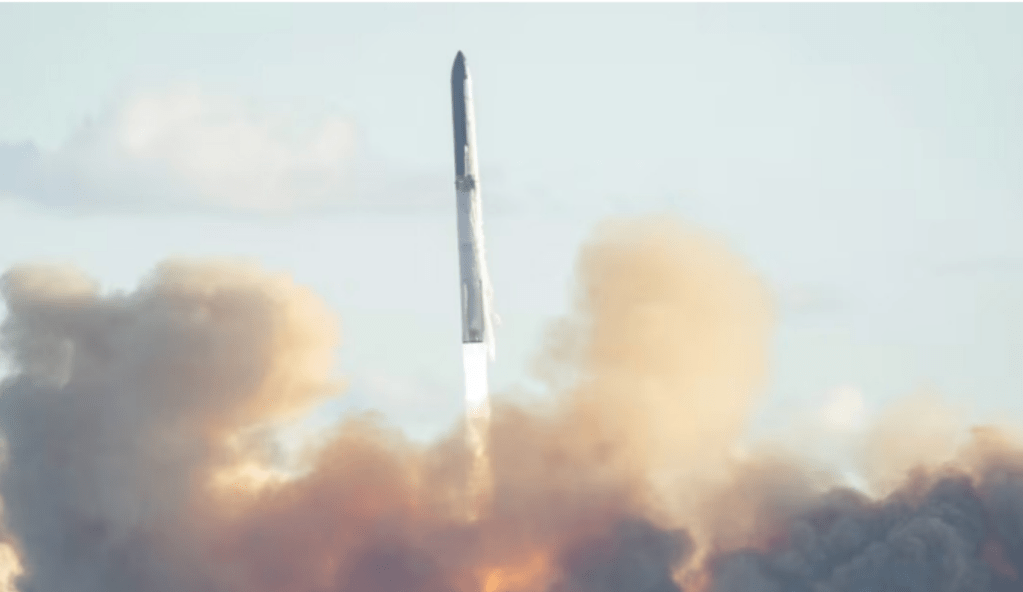
On October 13, SpaceX carried out the 11th test flight of its Starship rocket from Starbase, Texas. It was not just another routine launch—it was the final flight of the Block 2 design, a moment that marked the transition from experimentation to maturity. After years of explosions, partial successes, and relentless iteration, SpaceX finally demonstrated that its fully integrated, fully reusable launch system could perform as intended.
The 11th flight was remarkable for both its precision and ambition. The Super Heavy booster, labeled B15-2, lifted off using 33 Raptor engines and later executed a carefully sequenced descent, throttling down from thirteen engines to five and then three for a controlled splashdown in the Gulf of Mexico. The upper stage, Ship 38, reached space and performed an in-orbit engine relight, a critical step toward orbital operations. It also released eight simulated Starlink satellites—an exercise in deployment mechanics for future mass satellite launches. During re-entry, the ship’s upgraded heat-shield tiles endured extreme thermal stress with minimal damage, confirming that Starship is inching closer to the goal of rapid reuse. This success made the flight far more than a technical rehearsal. It represented a proof of concept for a new model of space transportation—one in which rockets could be reused like airplanes, dramatically cutting the cost of access to orbit. By integrating engine relights, payload deployment, and partial recovery in a single mission, SpaceX showed that the dream of frequent, low-cost space travel is no longer theoretical.
The importance of Starship 11 also lies in what it enables. NASA’s Artemis program will rely on a customized Starship to land astronauts and equipment on the Moon later this decade. The same vehicle design could one day deliver cargo or humans to Mars. With a payload capacity exceeding 100 metric tons and the potential for full recovery of both stages, Starship promises to make deep-space logistics practical and feasible. Each test flight, therefore, brings the world closer to building a reusable “space highway” connecting Earth orbit, the Moon, and eventually other planets.
Technically, this flight marked the final chapter for the Block 2 series and the beginning of the Block 3 generation. The upcoming version will feature lighter structures, higher-thrust Raptor engines, and an innovative “catch arm” system allowing the booster to be recovered directly by the launch tower instead of splashing down at sea. If successful, such a mechanism could reduce turnaround times from months to days, making weekly or even daily launches conceivable.
Economically, the impact could be profound. A fully reusable heavy-lift rocket lowers the cost of placing satellites, supplies, or entire modules into orbit. It enables private companies, researchers, and governments to operate beyond Earth at a scale previously unimaginable. As launch frequency increases and manufacturing costs fall, a new ecosystem of orbital infrastructure—communications, fuel depots, in-space assembly—could emerge. Starship 11, in that sense, was not the culmination of a program but the first practical test of this future economy. SpaceX’s 11th flight also reshaped the competitive landscape of the aerospace industry. With the company’s continuous progress, traditional government-led models of exploration are giving way to commercial partnerships that combine public funding with private innovation. The success of this flight reaffirmed that reusable systems are not only technically feasible but economically necessary for the next century of exploration.
Ultimately, Starship 11 demonstrated that humanity has entered a new stage of spaceflight—one defined not by single heroic missions, but by reliability, efficiency, and scale. The image of the silver rocket rising from the Texas coast and returning through the atmosphere is more than a symbol of engineering triumph; it’s a glimpse of the infrastructure that will carry us to the Moon, Mars, and beyond. Starship 11 was not an ending. It was the beginning of a countdown—to orbit, to the lunar surface, and to a future in which reaching space becomes routine, affordable, and essential to human progress.



 The Red & White
Leave a comment