This October, the world paused to recognize fourteen distinguished individuals in their respective fields. Let’s take a closer look at the laureates and the discoveries that earned them the most prestigious recognition in their fields.
Winning the Nobel Prize in Literature this year, László Kransznahorkai was nominated “for his compelling and visionary oeuvre, that in the midst of apocalyptic terror, reaffirms the power of art.” Additionally, the Nobel Peace Prize was awarded to Maria Corina Machado “for her tireless work promoting democratic rights for the people of Venezuela.” Both of these individuals have devoted themselves to bettering society, rightfully deserving these honors, which will be formally awarded to them on December 10.
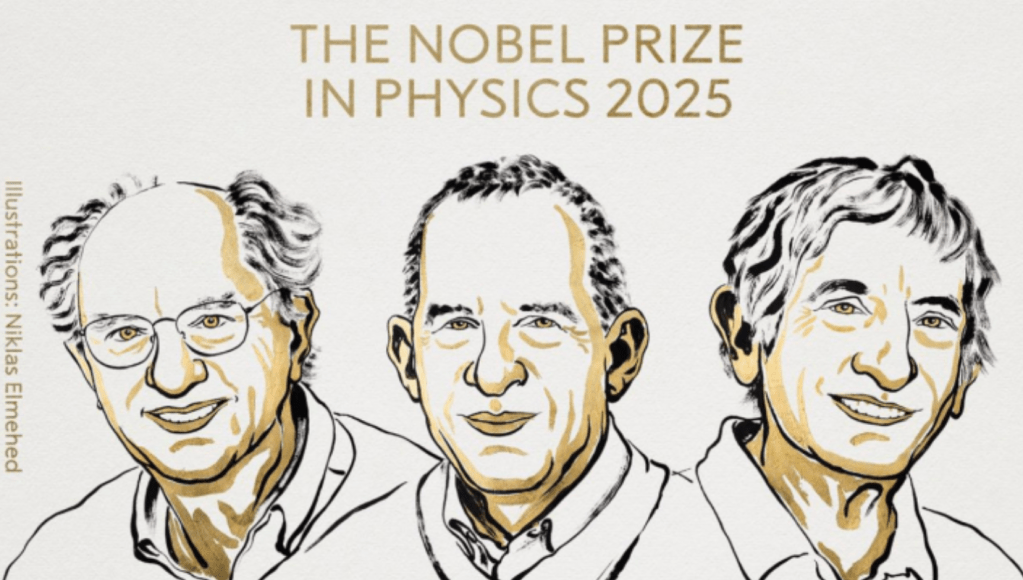
In the field of Physics, John Clarke, Michel H. Devoret, and John M. Martinis were recognized “for the discovery of macroscopic quantum mechanical tunneling and energy quantisation in an electric circuit.” Their experiments on a chip revealed quantum physics in action, opening doors to the next generation of quantum technologies. They demonstrated that energy can be isolated to observe quantization and macroscopic quantum tunneling. This work laid the foundation for exploring these phenomena in superconducting circuits, where engineered artificial atoms can be created.
The Nobel Prize in Chemistry went to Susumu Kitagawa, Richard Robson, and Omar M. Yaghi “for the development of metal-organic frameworks.” These molecular constructions contain large enough spaces to allow gases and other chemicals to flow through. Metal-organic frameworks have practical applications such as capturing carbon dioxide or storing toxic gases, representing a major advancement in chemistry and environmental science.
In Physiology or Medicine, the prize was awarded to Mary E. Brunkow, Fred Ramsdell, and Shimon Sakaguchi “for their discoveries concerning peripheral immune tolerance.” Their groundbreaking work revealed mechanisms that prevent the immune system from attacking the human body, laying the groundwork for new treatments for illnesses such as cancer and autoimmune diseases.
Finally, the Sveriges Riksbank Prize in Economic Sciences in Memory of Alfred Nobel was awarded to Joel Mokyr, “for having identified the prerequisites for sustained growth through technological progress,” and to Philippe Aghion and Peter Howitt, “for the theory of sustained growth through creative destructions.” These laureates have shown how innovation drives motivation for further progress. Their research also highlights that sustained economic growth cannot be taken for granted, as stagnation was historically the norm, reminding us to remain aware of the challenges to continued growth.
The 2025 Nobel Prizes celebrate the power of human curiosity, creativity, and perseverance across literature, peace, science, and economics. From exploring the frontiers of quantum physics to safeguarding democratic rights and advancing our understanding of the immune system, these laureates exemplify how dedication and insight can transform society. Their work inspires not only their peers but the next generation of thinkers and innovators who will continue to shape the world.


 The Red & White
Leave a comment